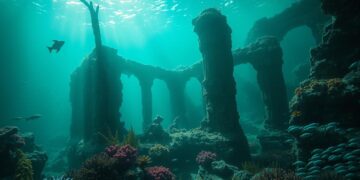
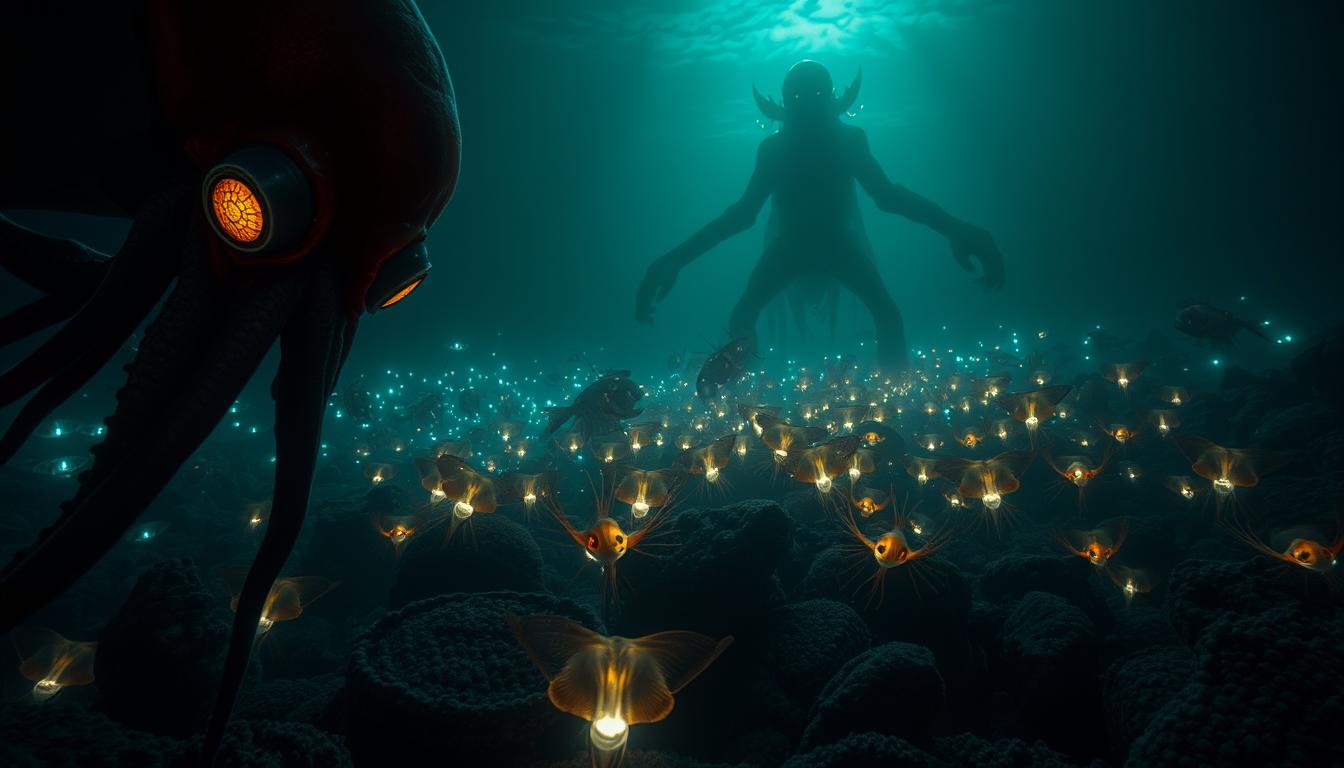
Imagine a world where fish glow in the dark and swim upside down. The ocean is home to deep sea creatures and mysterious ocean animals that amaze us. The leafy sea dragon, part of the seahorse family, is just one example.
The giant anglerfish lives at depths of 3,300 feet. These strange marine life forms thrive in total darkness. Some, like the red handfish, are found only in small areas like southeastern Tasmania.
Others, like wobbegongs, can be found in tropical waters. Over 300 anglerfish species exist in the Atlantic and Antarctic oceans. Yet, less than 20% of the ocean has been explored.
Dive into this hidden realm where creatures adapt to extreme conditions. Discover underwater oddities like the vampire squid and cerataspis monstrosa. These species are not just curiosities—they are vital to ocean ecosystems.
Join us as we uncover their secrets. From bioluminescent tricks to survival strategies, these creatures hold clues to evolution and conservation. This journey is more than a dive into the bizarre—it’s a window into life’s resilience and the urgent need to protect it.
Every twist of their biology tells a story of adaptation. From 20-centimeter leafy sea dragons to 1-meter anglerfish, their sizes vary as much as their habitats. But why does this matter?
These strange marine life forms hold clues to evolution and conservation. As we journey deeper, you’ll see how DNA barcoding and deep-sea trawling reveal species once mistaken for unrelated creatures. This is more than a dive into the bizarre—it’s a window into life’s resilience and the urgent need to protect it.
What Are Deep Sea Creatures?
Deep ocean life thrives in extreme environments. The deep sea starts where sunlight fades, around 200 meters down. It goes all the way to the ocean floor. This vast area is split into zones like the mesopelagic (200–1,000m), bathypelagic (1,000–4,000m), and the abyssal zone (4,000–6,000m). Here, creatures like giant isopods and Dumbo octopuses live under crushing pressure.
Even deeper is the hadal zone, home to animals like the Mariana hadal snailfish in trenches over 6,000 meters deep.
These creatures live in freezing temperatures and total darkness. Yet, life goes on. Vampire squids glide at 1,200m, while giant tube worms anchor themselves to hydrothermal vents. Creatures like the cookiecutter shark can withstand pressures that would crush submarines, adapting over millennia.
Some, like the fangtooth fish, have evolved jagged teeth for the dark depths. Even small animals like squat lobsters thrive at 8,579 meters. These zones are home to unique species, from glowing lanternfish to tripod fish that perch on the seabed. Understanding these layers shows how deep sea creatures conquer environments once thought uninhabitable.
Unique Adaptations of Deep Sea Creatures
Surviving in the deep sea requires special traits. Creatures face huge pressure, cold, and no light. Their deep sea adaptations are amazing examples of evolution. For example, the gulper eel can eat prey that’s twice as big as it is. This lets it survive in areas where food is hard to find.
The frilled shark has a body like an eel. This helps it move slowly on the seafloor, saving energy in areas with little food.
At 10,000 meters, the pressure is like 8 tons on every square inch. Many fish don’t have swim bladders to avoid being crushed. Their bodies are soft and their cells are special to handle the pressure. Even their chemistry changes to protect them, like the snailfish near the deepest parts of the ocean.

Many deep-sea creatures can’t see, but they find other ways to sense their surroundings. The northern stargazer has its eyes and nostrils on top of its head. This lets it hunt while buried in sand. About 90% of deep-sea animals use bioluminescence, or light, to communicate and hide.
Every unique feature, from stretchy stomachs to light-making organs, shows millions of years of evolution. These creatures show us that life can thrive in the most extreme places on Earth.
Creatures That Glow: Bioluminescent Species
Imagine diving into the ocean’s depths where sunlight can’t reach. Here, bioluminescent sea creatures light up the darkness like living lanterns. They create their own light through chemical reactions involving luciferin and luciferase. This light is stored in special organs called photophores.
Over 76% of marine species in the deep sea use this deep sea bioluminescence. It’s their main way to survive and thrive in the dark.
The anglerfish’s glowing lure draws prey toward its jaws. The vampire squid flashes bright displays to confuse predators. Some, like the dragonfish, can see red light—a rare ability that lets them hunt others blind to this wavelength.
Even the tiny cookie-cutter shark uses light patterns to lure larger fish. Then, it takes bites from their bodies.
Bioluminescence isn’t just for hunting. The glass squid uses blue-green light for camouflage, matching the faint sunlight above. Even microscopic plankton, like dinoflagellates, glow when disturbed. This creates mesmerizing waves of light.
Scientists study these light-producing marine life to develop medical tools. They use them to study cells and tumors.
From glowing worms releasing “bombs” of light to eels absorbing 99.7% of light to stay hidden, these creatures turn darkness into a tool. Their shimmering adaptations remind us how life adapts—even in Earth’s most extreme environments.
The Top 10 Strangest Deep Sea Creatures
Explore the weirdest ocean creatures hiding in the deep. The vampire squid from hell (Vampyroteuthis infernalis) isn’t a squid but a unique cephalopod. It has a cloak-like webbing between its arms.
Dive deeper to meet the Bobbit worm, a 3-meter-long ambush predator. It lurks in seafloor sands, striking prey with lightning speed.

Bizarre sea animals like the harp sponge (Chondrocladia lyra) thrive 3,000 meters deep off California. Its branching, Velcro-like hooks trap tiny prey. The pink see-through fantasia sea cucumber shows its beating heart and digestive tract through translucent skin—a survival trick in eternal darkness.
Strange marine species such as the gulper eel have jaws that unhinge to swallow creatures larger than themselves. Yeti crabs farm bacteria on hairy claws, while peacock mantis shrimp deliver punches powerful enough to shatter glass. The fangtooth fish, the world’s smallest but most toothy vertebrate, hunts at 5,000 meters.
Unusual underwater life includes the giant isopod, a 20-inch deep-sea woodlouse cousin, and the Dumbo octopus, Earth’s deepest-living octopus flapping “ear” fins. These creatures’ extreme adaptations—from transparent bodies to bone-crushing claws—prove the ocean’s endless mysteries. Each species, from the faceless cusk eel to the 13-foot Japanese spider crab, redefines life’s possibilities in the crushing blackness.
The Role of Deep Sea Creatures in the Ecosystem
Deep sea ecology depends on creatures like sea pigs and giant siphonophores. They keep the ocean’s ecosystem in balance. Sea pigs eat “marine snow” at depths of 1,200 to 5,000 meters. This process recycles nutrients and helps store carbon, preventing buildup on the seafloor.
The 40-meter-long giant siphonophore filters water. It supports the marine food web by distributing nutrients. This helps all parts of the ecosystem.
These species connect the surface and deep environments. Organisms migrate vertically, carrying food from sunlight zones to the abyss. This ensures energy flows through the marine food web, supporting fish populations and coastal ecosystems.
Abyssal plains, covering half Earth’s surface, host slow-growing species. These species take years to mature and are vulnerable to human threats like bottom trawling.
“Over 90% of deep-sea species remain undescribed, yet their survival faces risks from pollution and climate shifts.”
Changes in surface waters, like warming or acidification, harm deep ocean biodiversity. Oxygen minimum zones, expanding due to human activity, shrink habitats for species like tuna and marlin. Protecting deep-sea life is key to preserving the ocean ecosystem balance we all depend on.
With abyssal temperatures near freezing, even small changes can affect ecosystems. Conservation efforts must focus on these unseen networks before damage is done.
Endangered Deep Sea Species
Deep-sea creatures are in big trouble because of humans. Over 37% of sharks and rays are now endangered marine species. Threatened deep sea life is fighting to stay alive.
The angelshark, looking like a pancake, hides in sand but can’t escape nets. Eight of its species are critically endangered. Their slow growth makes recovery very hard.

Climate change makes things even worse. Vaquitas, tiny porpoises in Mexico, are almost gone, with fewer than 30 left. North Atlantic right whales are down to about 300, with no new calves to help their numbers grow.
Scientists want to protect these creatures. They suggest no-fishing zones and better fishing gear. But it’s hard to enforce deep sea protection over such a big area.
Protecting these species is key to saving entire underwater worlds. We need to act fast to save them before we lose them forever.
Mysterious Deep Sea Habitats
Deep ocean environments are some of Earth’s least understood places. Hydrothermal vent ecosystems thrive where boiling hot springs erupt from the seafloor. These undersea geysers fuel life without sunlight, supporting creatures like the polychaete worm, which thrives in water hotter than 350°F.
Such extreme conditions defy traditional survival norms. They show us marine habitat diversity in ways we’re only beginning to grasp.
Deep sea geography shapes life in unexpected ways. At 500 feet down, sunlight vanishes entirely, leaving darkness where bioluminescent species dominate. Oxygen levels drop drastically too—by 700 feet, oxygen is just 10% of surface levels.
Yet life persists. Abyssal plains, seamounts, and trenches each host unique species. The leafy sea dragon’s leaf-like fins mirror coastal seaweed, a survival trait tied to its Australian habitat.
Exploration reveals surprises. The East Pacific Rise’s volcanic ridges host tubeworms and crab species adapted to mineral-rich plumes. Deep-sea octopuses guard eggs for years—some for five years straight—to survive scarce food.
With only 26% of the seafloor mapped, discoveries like these hint at untapped marine habitat diversity. Technologies like ROVs and AUVs now map these zones, uncovering species like those found by MBARI’s 200+ new species cataloged in 2018.
As mining interests target deep-sea minerals, protecting these fragile deep ocean environments grows urgent. Each vent, trench, and plain tells a story of resilience—and our need to explore responsibly before they vanish.
The Future of Deep Sea Research
Advances in deep sea exploration are opening new frontiers for understanding life’s mysteries. New ocean research technology like autonomous vehicles and eDNA sampling now let scientists study species like the Dumbo octopus. This octopus was filmed alive at 7km depths in 2019. These tools are changing how we uncover underwater discovery secrets, from genome sequencing to 3D imaging.

Recent breakthroughs show how marine science advancement is speeding up. In 2022, comb jellies like Tjalfiella tristoma were found in the Atlantic, revealing new species through genetic analysis. A 2021 study used MicroCT scans and eDNA to study these creatures, cutting research time from decades to minutes. Genomic studies on four deep-sea animals even uncovered genomes 10 times larger than humans’, hinting at unseen biological diversity.
Teams like NOAA and Schmidt Ocean Institute’s collaborations show how partnerships drive progress. Innovations like folding sampling tools and laser imaging let researchers preserve specimens intact. These methods are vital as climate change threatens marine life—species vanish 100 times faster than natural rates. Every deep sea exploration mission brings us closer to protecting these fragile ecosystems before it’s too late.
Fascinating Facts About Deep Sea Life
Did you know the deep sea covers 95% of Earth’s living space? Check out interesting ocean facts like the peacock mantis shrimp’s punch—clocking speeds of 50 mph—capable of shattering aquarium glass. Learn more about deep sea trivia such as the box crab’s courtship dance: males cling to females for weeks until they molt, ensuring mating success. These amazing sea creature abilities show us new ways life can exist.
“The ocean’s depths are a library of life we’ve barely started to read.” – NOAA Ocean Exploration
The Costasiella sea slug steals algae’s chloroplasts to photosynthesize, a marine biology facts wonder. At the Mariana Trench, creatures survive pressures equal to 50 jets stacked overhead. Even the tiny Dumbo octopus, no bigger than a ruler, thrives 13,000 feet down. These adaptations show life’s creativity in darkness.
Myths say the deep is barren, but 90% of deep-sea species glow with bioluminescence. The giant squid? Outshined by the 400-year-old Greenland shark as the true deep-sea elder. With 20 million tons of dissolved gold lurking in its waters, the ocean’s secrets remain untold—waiting for curious minds to uncover them.
How to Learn More About Deep Sea Creatures
Deep sea education begins with curiosity. Watch documentaries like BBC’s Blue Planet II or David Attenborough’s specials. They feature creatures like the elusive leafy sea dragon.
Books by marine biologists and websites from NOAA and MBARI provide free learning resources. Follow their blogs or social media for updates on deep-sea discoveries. For example, the giant deep-sea isopod was found at 2,500 meters in the Gulf of Mexico.
Join citizen science programs to help research sea creatures. Use apps like iNaturalist to report marine sightings. Virtual tours from museums showcase creatures like the vampire squid, found in the tropical Atlantic.
Public aquariums often host talks on deep-sea species. For example, they discuss the dumbo octopus, found at 4,840 meters in the Porcupine Abyssal Plain. Listen to podcasts like Ocean Matters for insights into deep-sea mining debates and 2023 regulations.
Every discovery, from the 2021 slickhead fish to the 2022 Clarion-Clipperton Zone expeditions, reveals how much we don’t know. Share what you learn to inspire others. Your interest helps protect fragile ecosystems.
By supporting ocean learning, you help safeguard habitats. Over 1.75 million species await discovery. This ensures their survival for future generations.